Overview:
- 16 September 2026 is CDP’s standard A response submitted by the standard scoring deadline and meeting the applicable eligibility requirements so it can enter CDP’s regular scoring process. submission deadline.
- CDP states that the cutoff is 11:59pm The UTC-12 time zone used by CDP for the cutoff. It is the final time zone in a calendar day, so convert it carefully for your local team..
- Standard edits can continue after the scoring deadline until the final response window closes, but those later edits are not included in the standard score. CDP’s Terms also describe a limited on-demand scoring route for some late submissions through 30 September.
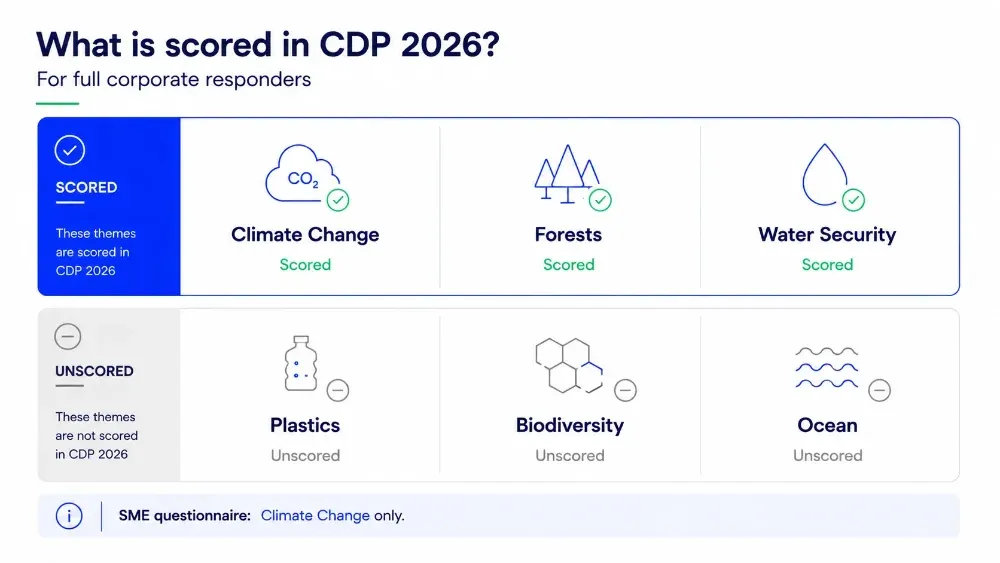
- Full corporate scoring covers Climate Change and, where applicable, Forests and Water Security in 2026. Plastics, Biodiversity and Ocean remain unscored.
This checklist is designed for sustainability, finance, risk, procurement and reporting teams carrying out the final submission review.
Useful before the final review
Keep CDP’s 2026 scoring materials open alongside your tailored Portal guidance. Take a look at Sweep’s CDP score guide for tips on how to improve your score, and our CDP reporting overview.
At this stage, the biggest CDP risk is often a late-stage disconnect: a data owner changes a number, a narrative no longer matches the metric, an Essential Criterion is missed, or the person authorized to submit is unavailable when the response is ready. Teams that already use structured sustainability reporting workflows should use the final review to carefully wrap things up, with clear ownership and a frozen source of truth.
For a broader explanation of the questionnaire and how it fits into corporate disclosure, see Sweep’s CDP reporting overview.
1. Lock the deadline and submission plan
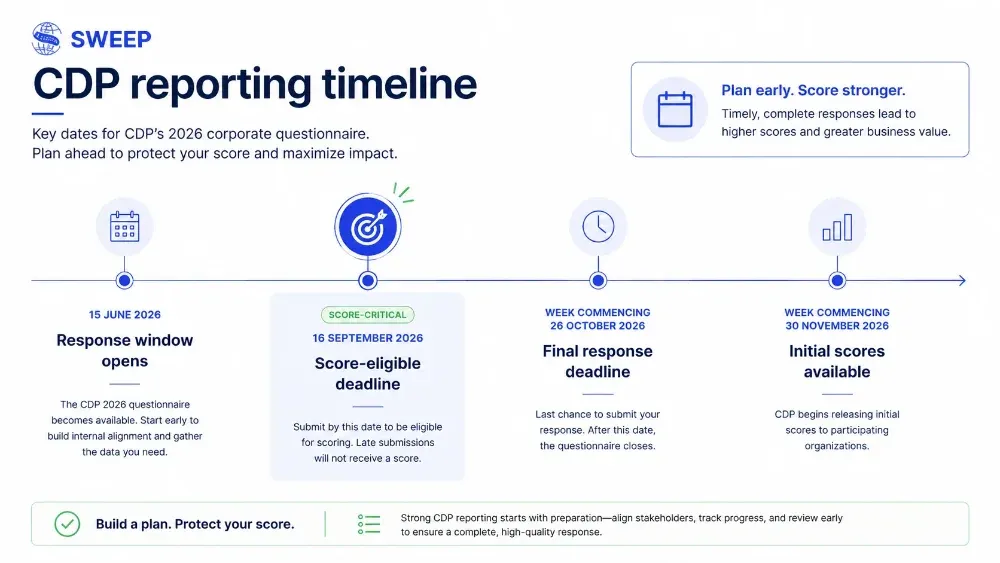
CDP’s 2026 scoring deadline is 16 September 2026. CDP states that score-eligible responses must be submitted by 11:59pm International Date Line West. Check the CDP 2026 Disclosure Hub and your Portal notifications before submission, since CDP can issue cycle-specific updates.
Build an internal deadline several hours earlier. Portal access, final approvals, supporting evidence and unexpected mandatory fields are operational issues, not scoring strategy. They need contingency time.
16 September is the standard scoring close, not the final day the Portal accepts edits.
CDP says organizations can continue to submit and edit responses until the final response deadline in the week commencing 26 October. Those later edits are not included in the standard score. Separately, CDP’s 2026 Terms of Disclosure describe a limited, paid on-demand scoring option for responses submitted after the scoring deadline but on or before 30 September, subject to availability.
| Milestone | 2026 timing | What it means for your team |
|---|---|---|
| Response window opened | Week commencing 15 June | Questionnaire completion and Portal submission period. |
| Scoring deadline | 16 September | Score-critical Submit the response you want CDP to score. |
| Final response deadline | Week commencing 26 October | Unscored responses and later amendments can still be submitted until closure. |
| Initial score release | Week commencing 30 November | Scores become available to disclosers in the CDP Portal before/around public release. |
2. Clear the score-eligibility gates first
Before reviewing individual answers, confirm that nothing administrative can block submission. CDP requires corporate disclosers to confirm the Submission Lead, complete the admin fee step where applicable, and set up the questionnaire before submitting. The current process is set out in CDP’s How to Disclose guidance.
Then confirm what is actually scored for your pathway. For Full corporate responders in 2026, CDP scores Climate Change and, where applicable, Forests and Water Security. Forests and Water Security applicability depends on questionnaire setup and CDP’s industry impact classification. Plastics, Biodiversity and Ocean are unscored. The SME questionnaire is scored for Climate Change only.
A finished response may still be ineligible for scoring
- who is responsible for submitting it;
- whether the fee has been paid;
- whether the questionnaire is set up correctly;
- which language to use; and
- which environmental issues your organization must report.
3. Run a final data quality review
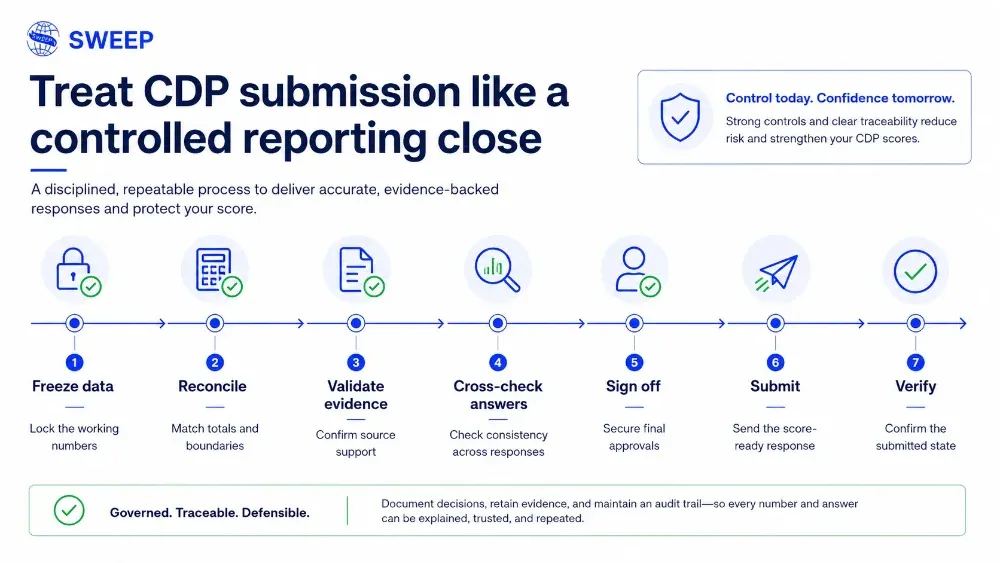
The last review should work like a reporting closure. Freeze the working numbers, reconcile the source data, validate evidence, cross-check linked answers, complete sign-off, submit, then verify the submitted state. If your team is still re-keying the same sustainability data across systems, Sweep’s carbon management approach shows how traceable source data can reduce that late-stage reconciliation burden.
Reconcile the numbers
- Confirm Scope 1, Scope 2 and relevant Scope 3 totals reconcile to the source inventory used elsewhere in the organization.
- Check that reporting boundaries, base years, consolidation approaches and recalculations are described consistently.
- Reconcile energy, water, commodity or activity data to the numbers cited in targets, risks, opportunities and transition-plan answers.
- Review unusual year-on-year movements and make sure material changes have an explanation.
- Confirm units, currencies, percentages and reporting periods. A correct number in the wrong unit can still create a weak response.
Reconcile the narrative
Question-level accuracy is only half the job. The response also needs to stay consistent across governance, strategy, risks, targets, verification and performance. A changed Scope 1 figure, for example, can affect target progress, financial effects, transition planning, assurance coverage and the explanation of year-on-year movement.
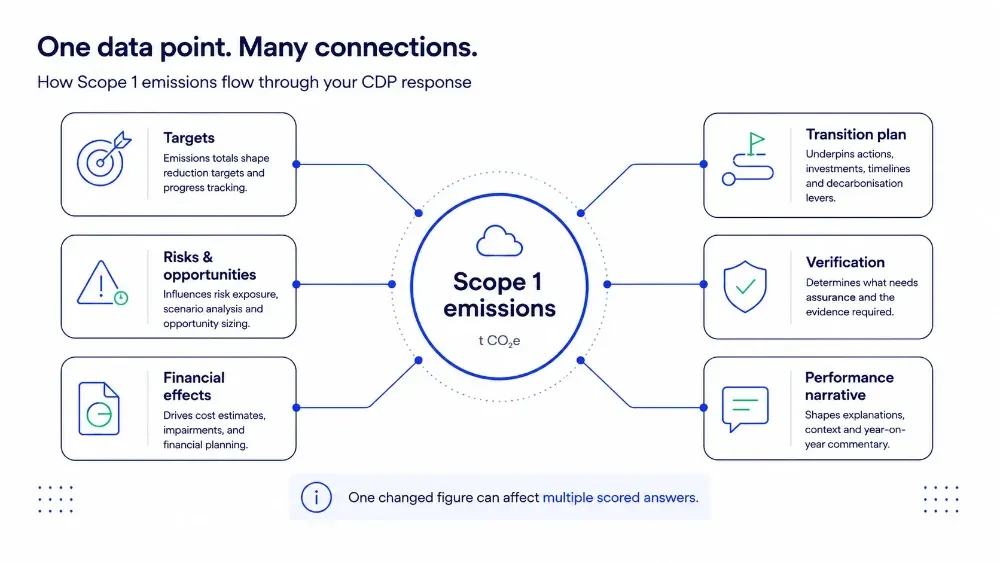
Useful final-pass test
Pick five material claims in the response and ask: “Where is the evidence, who owns it, and does another answer contradict it?” This is often faster at surfacing real issues than reading the questionnaire from top to bottom one more time.
4. Review the response through the scoring lens
CDP’s Full corporate scoring framework progresses through four maturity levels: Disclosure, Awareness, Management and Leadership. A final review should test more than completion. Check whether the evidence, controls and actions support the score level your answers appear to claim.
Use CDP’s tailored scoring methodology in the Portal alongside the 2026 scoring materials on the How to Disclose page. Sweep’s guide to improving your CDP score provides additional practical context, but CDP’s own methodology remains the scoring authority.
| Level | Score band | Final review question |
|---|---|---|
| Disclosure | D / D- | Have we supplied the requested information completely and consistently? |
| Awareness | C / C- | Do our answers show a clear understanding of environmental dependencies, impacts, risks and opportunities? |
| Management | B / B- | Do we evidence active processes, controls and actions rather than intentions alone? |
| Leadership | A / A- | Do we meet CDP’s best-practice expectations and every relevant Essential Criterion for the level? |
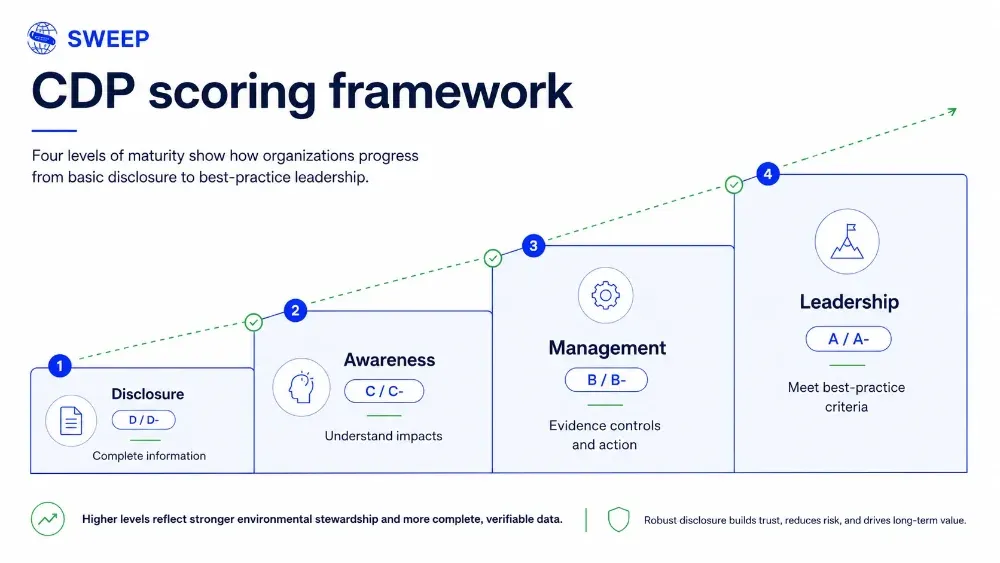
Focus the last scoring pass on high-value questions, dependencies, conditional logic and Essential Criteria. CDP publishes its 2026 scoring introduction, scoring changes, Essential Criteria, category mappings and category weightings through the same scoring materials hub.
5. Do a theme-by-theme stress test
Use the expandable sections below as a final prompt for the environmental issues scored in the CDP’s main corporate questionnaire, distinct from the SME questionnaire. It has broader environmental issue coverage and scoring requirements for larger organizations. where they apply to your organization. Your tailored questions and score opportunities depend on questionnaire setup, sector and environmental issue applicability, so use this as a review aid rather than a substitute for CDP guidance.
6. Secure final internal sign-off
Late changes become risky when reviewers are unclear about who owns the data or who can approve a correction. Establish a short final sign-off chain and freeze the response after approval unless a material error is found. Cross-functional workflows are also a core part of structured sustainability reporting, where finance, procurement, operations and ESG teams need to work from the same controlled information.
- Sustainability/ESG: owns the full response and scoring logic.
- Finance: validates financially material assumptions, reported financial effects and relevant data controls.
- Operations/EHS: confirms operational activity and environmental data.
- Procurement: validates supplier, commodity and value-chain information.
- Risk/legal: reviews material risk language, governance statements and sensitive disclosures where needed.
- Executive owner: confirms the response reflects the organization’s approved position.
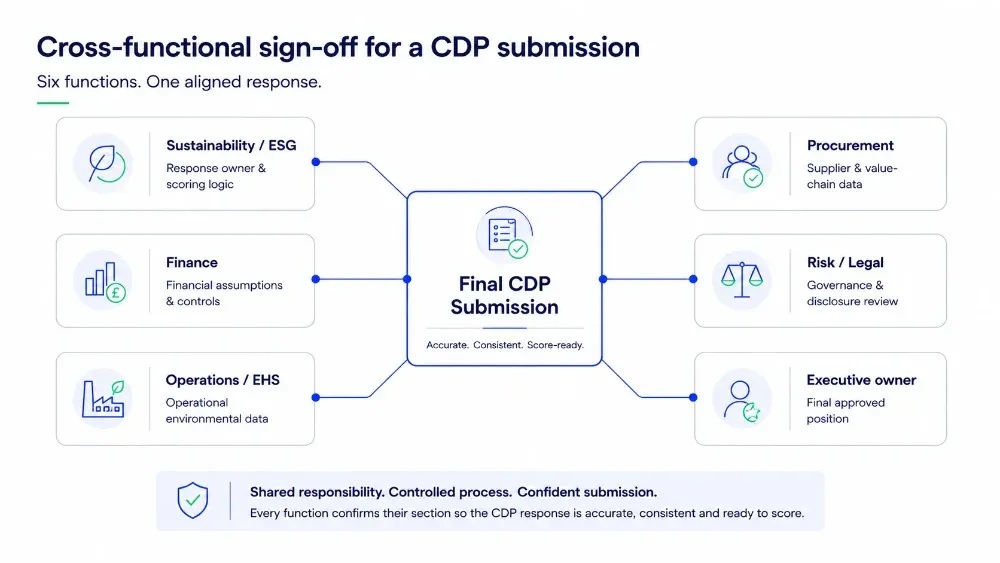
Set a change-control rule.
Once final sign-off is complete, require every proposed change to name the question affected, reason for the change, data owner, evidence source and approver. This prevents a “small” edit from quietly creating contradictions elsewhere.
7. Final CDP 2026 submission checklist
Use this as the final pre-submit control. Tick each item as you review it; selections apply to the current page view and are not stored after refresh.
8. Submit from the Portal, then verify the submitted state
The final control is simple: the version reviewed must be the version submitted. If drafting happened outside the CDP’s online disclosure system where authorized users complete, review and submit the organization’s response., compare the final working copy with the live questionnaire. CDP’s submission and editing guidance explains the The CDP user role with authority to submit the organization’s response. Confirm this person has access and is available before the deadline. process and amendment steps.
- Confirm prerequisites. Check fees, permissions and required fields.
- Run Portal checks. Resolve unexpected mandatory fields.
- Review the live response. Check the version the Submission Lead will submit.
- Submit early. Work to your internal deadline, not the cutoff.
- Retain proof. Save confirmation and the final submitted copy.
Corrections before the scoring deadline: follow CDP’s amendment process and resubmit where required. An edited draft is not automatically the scored response.
Final Portal comparison
- Core facts: reporting year, The entities, operations and activities included in reported environmental data. It should stay consistent across totals, targets and narrative answers., units, currencies and emissions totals.
- Dependent fields: recheck dropdowns and Questions that appear, disappear or change applicability based on earlier responses. A late answer change can therefore create new fields to review. after late edits.
- Attachments: open supporting files in the Portal and confirm the correct version and access setting.
Keep a submission record
- Approval: who approved the response, and when.
- Submission: who submitted it, plus the timestamp.
- Evidence: where the final response and evidence pack are stored.
9. What happens after 16 September?
After 16 September, the response moves into CDP’s scoring and review process. CDP says initial 2026 scores will be available in the week of 30 November. See its score guidance for the release sequence.
What changes after the cutoff?
- Standard scoring is locked. Edits after 16 September do not change the standard score.
- Late scoring is limited. CDP’s 2026 Terms allow some responses submitted by 30 September to request an A separate paid scoring route described in CDP’s 2026 terms for certain late submissions. It is subject to timing, capacity and availability, so it should not be treated as the standard route. for a fee, subject to availability.
- The response window remains open. Corrections can support record accuracy until the week commencing 26 October, but they do not affect the standard score.
What should your team do next?
- Capture friction. Log the questions that caused late data chasing, repeated assumptions or manual reconciliation.
- Preserve the data trail. Keep final CDP figures linked to the source data used in investor, regulatory and management reporting.
- Prepare the next cycle. Turn those lessons into a control list for the 2027 reporting cycle.
Keep one controlled version of key facts. Sweep’s sustainability reporting approach helps teams reuse governed data across reporting requirements rather than rebuild the same evidence for each disclosure.
10. Common last-minute blockers
Most final-week problems come from three operational gaps. Resolve these before they become submission issues.
- Ownership gaps. A key figure or answer is still waiting on a data owner, reviewer or approver.
- Connected changes. A late correction affects other questions, totals, targets or supporting narrative.
- Version uncertainty. The team cannot quickly confirm which workbook, document or Portal answer is approved.
Escalate score-critical issues immediately. If a change affects a scored answer, an A minimum scoring requirement used by CDP. Missing an applicable Essential Criterion can prevent progression to a higher score level even when other answers are strong., a reported total or the ability to submit, route it to the response owner and approver. Minor wording preferences can wait.
We are still waiting for one data owner. Should we delay the whole response?
Assess materiality immediately. If the missing input affects scored content or a dependency, escalate it and use the best supportable information available rather than letting one unresolved item consume the final hours.
A figure changed after sign-off. What should we recheck?
Trace the figure through every connected answer, including targets, intensity metrics, risks, transition plans, narrative explanations and verification coverage.
Can we improve the response after 16 September?
You can amend the response while the final response window remains open, but those edits do not change the standard score. CDP also describes a limited paid on-demand scoring route for some late submissions.
Do Plastics, Biodiversity or Ocean affect our 2026 corporate score?
CDP states that these issues remain unscored for companies in 2026. Climate Change is scored for Full corporate responders, with Forests and Water Security scored where applicable.
11. A practical final 48-hour plan
Use the final two days as a controlled sequence rather than a general editing window. Freeze the core numbers first, then allow only changes that have a named owner and a clear reason. Every material change should trigger a targeted recheck of connected questions. If Scope 1 emissions change, for example, the team may need to revisit totals, targets, intensity calculations, verification coverage, risks and transition plan commentary. The cross-answer map above shows why a single late edit can travel further than expected.
Assign one person to maintain the live issue log. Each item should show the question reference, owner, status, decision and whether another answer needs to be checked. This avoids parallel conversations in email, chat and spreadsheets producing conflicting instructions. By the final 12 hours, the issue list should be short and operational: submission permissions, Portal validation, final approval and confirmation that the submitted state has been saved.
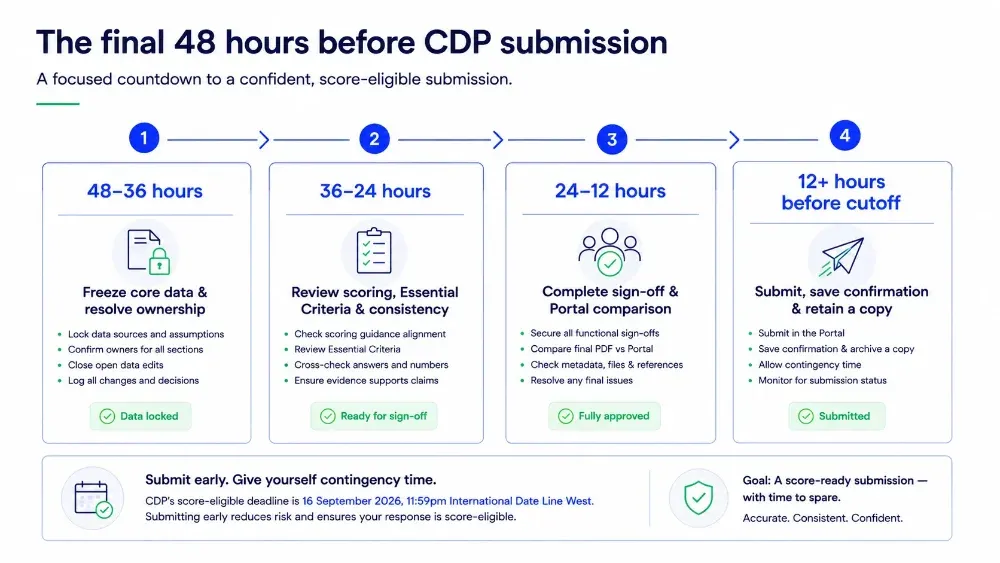
| Window | Priority | Output |
|---|---|---|
| 48-36 hours | Freeze core data and resolve open ownership questions. | Stable dataset and named approvers. |
| 36-24 hours | Run scoring, Essential Criteria and cross-answer consistency review. | Short list of score-critical fixes only. |
| 24-12 hours | Complete final sign-off and Portal comparison. | Approved submission version. |
| 12+ hours before cutoff | Submit, save confirmation and retain an internal copy. | Score-eligible response submitted with contingency time. |
Do not use the deadline as your submission time.
Portal access, permissions, unexpected mandatory fields and last-minute reviewer availability are all avoidable operational risks. Give the team enough time to recover from a submission issue without turning it into a scoring issue.
How Sweep supports a controlled reporting close
Sweep, the sustainability intelligence platform, helps complex organizations connect carbon and ESG data, reporting workflows, supplier collaboration and operating systems. For CDP teams, the practical value is a more traceable reporting process: fewer disconnected spreadsheets, clearer ownership and a reusable data foundation across disclosures.
- Carbon management for structured Scope 1, 2 and 3 data with traceability back to source information.
- Sustainability reporting for governed workflows, validation and multi-framework reporting from a controlled dataset.
- Supplier emissions for collecting and managing value-chain data across procurement networks.
- CDP reporting support for teams preparing and managing their disclosure process.
Software can support data quality, workflow and audit readiness. It does not guarantee a particular CDP score or regulatory outcome. The submitted response still needs to satisfy CDP’s current questionnaire, scoring criteria and eligibility rules.
Primary CDP resources: 2026 Disclosure Hub, How to Disclose and scoring materials, submission and amendment guidance, score release and eligibility guidance, and 2026 Terms of Disclosure. Always check the CDP Portal for organization-specific notifications or deadline changes.