Sustainability in Action 2026: New Report from Sweep and Capgemini

Read the report

Sweep Named a Leader in IDC MarketScape 2026 for Carbon Management

Get the report

Sweep named a Leader in the Verdantix 2026 Green Quadrant for enterprise carbon management

Get the report

🇫🇷
Bonjour! We noticed you speak French.

Would you like to browse our site in French?

Product carbon footprints at scale: A practical guide for manufacturers

Learn how to calculate, update, and manage product carbon footprints at scale, from shared components and supplier data to emissions reductions
PCF for manufacturers
Category
Guides
Last updated
October 22, 2026

Product specifications change. Supply chains shift. Production processes evolve. But are your product carbon footprints keeping up?

For manufacturers managing hundreds or thousands of SKUs, calculating a product carbon footprint (PCF) is only the beginning. Keeping those calculations accurate as materials, specifications, and production conditions change is essential for identifying emissions reductions and meeting customer requirements.

In this guide, we explore how manufacturers can calculate and manage PCFs across their product portfolios, keep emissions data up to date, and turn carbon insights into better manufacturing decisions.

Why product carbon footprints become harder to manage at scale

A manufacturer might manage hundreds or thousands of products, each with different materials, suppliers, and requirements, many of which will share components, manufacturing processes, or production facilities.

That means changes to product specifications or manufacturing conditions, no matter how small, can affect multiple product carbon footprints (PCFs) across several product families at once. 

Without a consistent way to manage the underlying data, manufacturers risk relying on outdated calculations, duplicating assessment work, or overlooking opportunities to reduce emissions.

How to calculate product carbon footprints across a manufacturing portfolio

The following four-step process builds on the standard product carbon footprint calculation process, with a focus on managing large manufacturing portfolios.

1. Group products into families and identify shared components

Any calculation starts by organizing products into families based on similarities in their materials, design, and manufacturing processes. Products that share components or production routes often use common calculation inputs, reducing duplicated work.

Manufacturers can group products according to:

  • Material type or grade
  • Shared components
  • Manufacturing processes
  • Production facilities
  • Product design and specifications

Each SKU should still retain its own material quantities, production requirements, and other relevant inputs to ensure its PCF accurately reflects the product being assessed.

2. Connect BOMs with supplier and production data

A BOM identifies the materials and quantities required to manufacture a product. Manufacturers need to link this information to the emissions associated with the materials and the processes used to produce the finished component.

Relevant data includes:

  • Materials: Material types, quantities, and associated emission factors
  • Suppliers: Supplier-specific emissions data, where available, and the source of purchased components
  • Production: Energy consumption, manufacturing processes, and relevant allocation factors
  • Facilities: Production locations and differences in energy sources or manufacturing conditions
  • Transportation: Relevant inbound and outbound transport activities, depending on the assessment boundaries

Enterprise resource planning (ERP) and product lifecycle management (PLM) systems can provide product specifications and operational data, while supplier engagement helps fill gaps in upstream emissions information.

3. Calculate PCFs consistently and identify portfolio-wide hotspots

With product, supplier, and production data connected, manufacturers can calculate PCFs using shared models and product-specific inputs.

Apply standardized calculation methods across the portfolio, including consistent system boundaries, functional or declared units, emissions factors, and allocation rules. Standards such as ISO 14067 and the GHG Protocol Product Standard provide a methodological foundation, alongside any applicable product category rules.

Once PCFs are calculated, manufacturers can identify recurring emissions hotspots across product families, such as a material used in hundreds of SKUs or an energy-intensive production process shared across multiple production lines.

4. Validate and document PCF results

Before using PCF results for customer reporting or internal decision-making, manufacturers should check the quality of their data and calculations.

It’s critical to document the emissions factors, calculation methods, reporting periods, and product specifications associated with each PCF. Where required, arrange verification in line with applicable customer or program requirements.

What changes should trigger a PCF review?

Not every manufacturing change requires a complete recalculation. However, changes that could materially affect a product’s emissions should prompt a review of the underlying data and assumptions.
Change Potential impact on the PCF
Supplier changes Different production methods or sourcing locations may affect upstream emissions
Material substitutions New material types, grades, or quantities can change the product’s embodied carbon
BOM or product design updates Changes to components, specifications, or product weight can affect emissions across lifecycle stages
Production process changes New equipment, process improvements, or changes in energy consumption can alter manufacturing emissions
Facility or energy source changes Moving production or changing energy sources can affect the emissions associated with manufacturing
Updated emissions data New supplier-specific information or revised emission factors may change previously estimated results


The significance of a change depends on its effect on the product, the assessment boundaries, and any applicable customer or reporting requirements. 

How to identify and update affected products

If a supplier updates the emissions data for an aluminum grade used across several product families, the manufacturer can identify which BOMs contain that material and which products need their PCFs reviewed.

The process might look as follows. 

  1. Confirm which material, supplier, process, or emissions dataset has changed
  2. Use BOMs and production records to identify the relevant components and SKUs
  3. Apply the new data to the appropriate products and reporting periods
  4. Check the effect on each PCF and validate significant changes before using the updated figures

Using shared calculation inputs can reduce repetitive work, particularly when the same material or component appears across multiple products.

Why version control and traceability matter

When a PCF changes, manufacturers need to understand what changed, when it changed, and why the result is different.

Maintaining a record of product specifications, data sources, emission factors, calculation methods, and effective dates makes it easier to review historical results and respond to customer questions.

It also helps teams distinguish actual emissions reductions from changes caused by improved data or revised calculation assumptions. For example, replacing an industry-average emission factor with supplier-specific data may change a PCF even if the manufacturing process itself remains unchanged.

A documented history of calculations gives manufacturers a more reliable basis for tracking product emissions over time and sharing results with customers.

MANUFACTURING EXAMPLE

One supplier change. Three products. Different carbon impacts.


A manufacturer sources the same aluminum grade for three components. From July, its supplier introduces a lower-emissions production process, which reduces the material’s cradle-to-gate emission factor from 8 to 5 kg CO₂e per kg of aluminum.

Although the products’ specifications remain unchanged, their aluminum-related emissions decrease. The manufacturer now needs to identify any affected products and update their PCF calculations for the relevant production periods.

Impact across three components

Product Aluminum used Before After Reduction
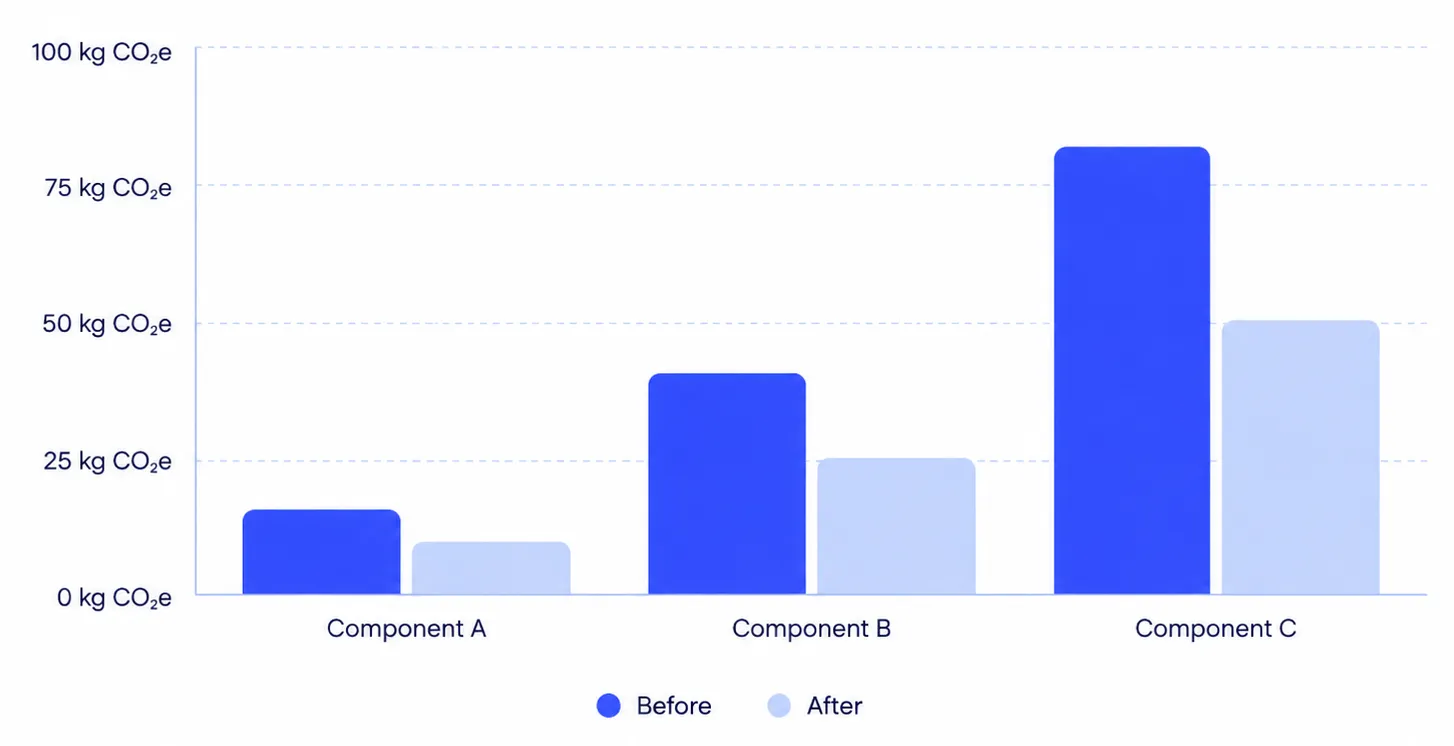
Component A 2 kg 16 kg CO₂e 10 kg CO₂e 6 kg
Component B 5 kg 40 kg CO₂e 25 kg CO₂e 15 kg
Component C 10 kg 80 kg CO₂e 50 kg CO₂e 30 kg

Aluminum-related emissions before and after the change

A comparison of emissions changes

What this means for manufacturers

The updated process reduces the aluminum-related emissions of each component by 37.5%, although the absolute reduction varies with the quantity used. By linking supplier emissions data to bills of materials (BOMs), manufacturers can identify affected SKUs and update their calculations consistently.

Since the change takes effect in July, earlier PCF records should retain the emissions data applicable to their original assessment periods.

Figures are hypothetical and illustrate only the aluminum-related portion of each PCF. They assume equivalent material quantities, system boundaries, and supplier coverage. They do not represent complete product footprints.

Turning portfolio-wide PCF data into manufacturing decisions

With reliable PCF data across their portfolios, manufacturers can now identify opportunities that might be missed when assessing products individually. 

These insights can inform decisions across engineering, procurement, sustainability, and commercial teams.

Prioritize changes with the greatest emissions impact

A material or manufacturing process used across hundreds of products may contribute more to a company’s total emissions than a high-emitting component produced in small quantities.

With visibility into product-level carbon intensity alongside production volumes, manufacturers can identify where improvements could deliver the greatest overall reductions.

Example: A manufacturer discovers that a moderately carbon-intensive aluminum component is used across 600 products, while a more carbon-intensive component appears in just 20. After assessing production volumes and potential reductions, the manufacturer decides to prioritize reducing emissions from the widely used component because it offers greater total emissions savings.

Support product development and procurement

PCF data helps engineering and procurement teams assess the carbon implications of product design and sourcing decisions.

Manufacturers can model how changes to material quantities, supplier selection, or production processes might affect a product’s emissions before implementing them.

Example: An engineering team compares two suppliers offering the same material specification. Using comparable supplier-specific emissions data, the team finds that one supplier’s production process generates fewer emissions. Procurement decides to qualify the lower-emissions supplier, subject to cost, quality, and delivery requirements.

Respond to customer tenders and RFPs with confidence

Manufacturers increasingly encounter requests for product-level emissions data during procurement, supplier assessments, and requests for proposals (RFPs). Maintaining accurate, traceable PCFs makes it easier to provide customers with emissions information that reflects current product specifications and production conditions.

Example: An automotive manufacturer receives an RFP requesting verified carbon footprint data for a specific component. Its sustainability and commercial teams retrieve the latest PCF, confirm that it meets the customer’s methodology and verification requirements, and include the supporting documentation in their submission. This allows the manufacturer to meet the emissions-data requirements of the tender without commissioning a new assessment.

How Sweep helps manufacturers manage PCFs at scale

Managing product carbon footprints across a changing manufacturing portfolio requires reliable product, supplier, and emissions data in one place. 

Sweep, the sustainability intelligence platform, combines scalable carbon accounting with AI-powered workflows to help manufacturers calculate defensible PCFs, identify emissions hotspots, and respond to customer requirements.

With Sweep, you can:

  • Calculate defensible PCFs in seconds: Upload a bill of materials (BOM), recipe, or packaging specification in any format, and Sweep calculates a PACT-aligned PCF by mapping components to emission factors and automatically addressing data gaps. Get a defensible, audit-ready result in-house, at your own pace.
  • Scale across your entire catalog, not one product at a time: Calculate, track, and manage thousands of SKUs from day one. Import new product data and expand your catalog without rebuilding your setup as your portfolio grows.
  • Let Sweepy do the technical work: Sweepy, Sweep’s AI assistant, recommends emission factors with confidence scores, maps them to your bill of materials, and checks data for gaps and errors. Your team can focus on reviewing and approving results rather than building every footprint from scratch.
  • Meet external requests head-on: Customers, subsidiaries, and procurement teams increasingly request product-level emissions data through RFIs and RFPs. Sweep generates PACT-aligned PCFs with a clear methodology trail behind every calculation, helping you respond confidently to customer requirements and compliance obligations.
  • Make reduction efforts count by targeting your highest-impact products: Sweep’s hotspot analysis helps you identify which products contribute most to emissions and where those emissions occur across the lifecycle. Use these insights to prioritize reductions across your manufacturing portfolio.
  • Stay audit-ready as your program scales: Sweep maintains an audit log of calculations, updates, and decisions behind each PCF, including AI-assisted actions. Start with estimates, incorporate more precise supplier data as it becomes available, and retain a clear history of how your results evolve.

With consistent product carbon data and AI-assisted workflows, manufacturers can spend less time managing calculations and more time improving products, reducing emissions, and meeting customer requirements.

Book a demo to discover how Sweep can help you calculate and manage product carbon footprints at scale.

Sweep can help

Sweep makes sustainability work for your business. Not the other way round. We connect all your sustainability data and turn it into business intelligence to help you unlock performance – from compliance and risk reduction, all the way to cost-savings, and market differentiation.

With Sweep, you can:

  • Lower costs through real-time tracking and insights
  • Strengthen supply chains with end-to-end visibility and engagement
  • Deliver audit-ready sustainability and climate reporting with confidence
  • Make sustainability intelligence available to everyone to optimize the business
See how we can help you on your sustainability journey